
For decades, there has been a great deal of misinformation circulating about the requirements for obtaining Polish citizenship by descent. This misinformation began to be disseminated by the Polish Embassy in Argentina through an informational brochure, which can be seen below. Since the information came directly from the Polish Embassy, this myth took firm root in the minds of those seeking Polish citizenship for over twenty years and deprived thousands of families of the Polish citizenship to which they are rightfully entitled.
Today I am going to decisively correct that misinformation so that everyone who was ever denied the opportunity to present their case for Polish citizenship has the chance to do so.
You have no chance of applying for Polish citizenship because a Polish woman married a foreigner before 1951. This is the infamous phrase that agents used to say, and it is based on point 2 of the embassy’s informational brochure:
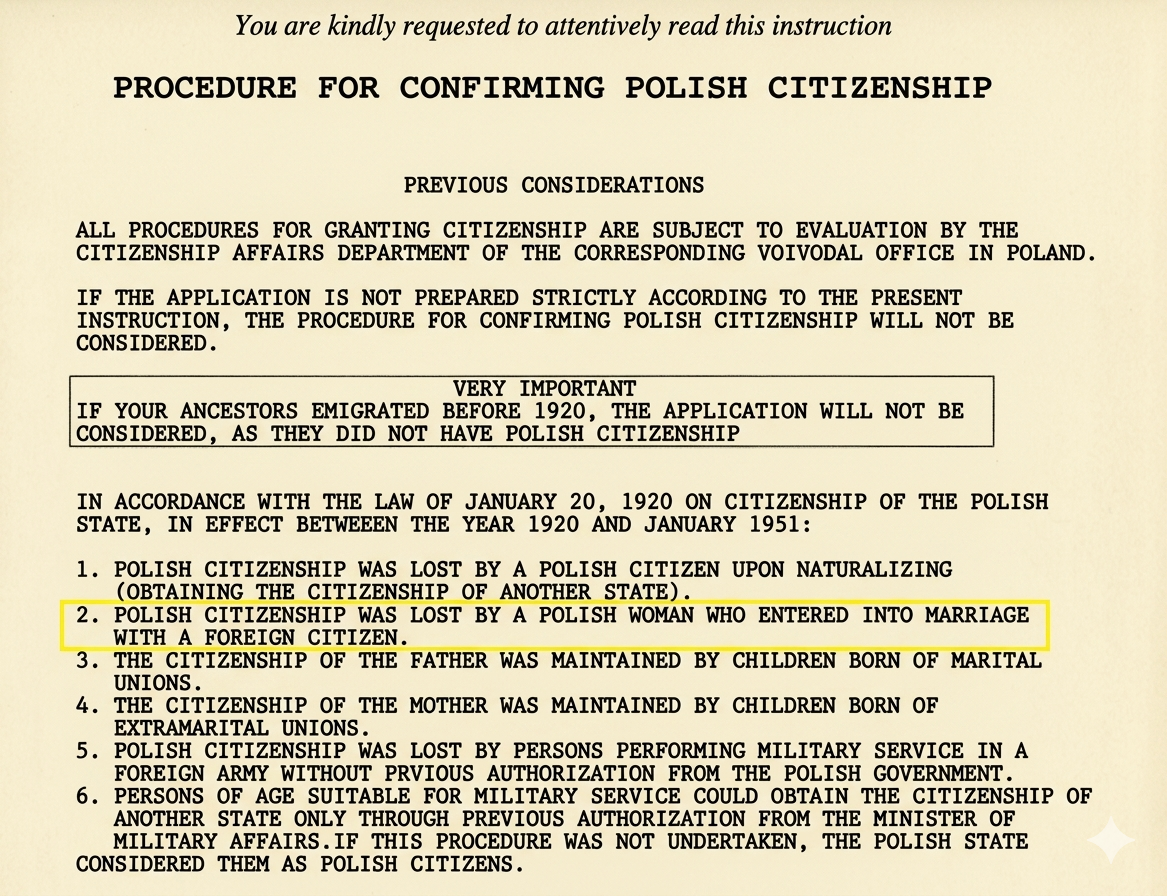
This misinformation is based on Article 10 of the Polish Citizenship Act of 1920.
English translation of Article 10.Article 10. A Polish citizen who, having married a foreigner, has lost Polish citizenship, regains it if she submits the relevant application to an administrative office in her place of residence upon the dissolution of her marriage and upon settling in Poland. You can find the original Article 10 in Polish Here.
A common misconception is that any woman who married a foreigner (non-Polish) before 1951 automatically loses her Polish citizenship. This is completely false.
The former Polish citizenship law did not allow a woman to hold dual citizenship. Therefore, if, under the laws of the foreign country, a Polish woman acquired her husband’s citizenship by marrying a citizen of that country, she would lose her Polish citizenship upon obtaining foreign citizenship. However, the loss of Polish citizenship is not a direct result of the marriage; it is a result of her acquiring her husband’s citizenship.
There are few countries where this occurred, and each individual case must be examined to determine whether the woman actually acquired her husband’s citizenship. In some cases, if the couple married outside the man’s home country—for example, if they married in Argentina—the husband’s country did not recognize the marriage, and therefore the woman did not acquire her husband’s citizenship.
Example where the woman does lose Polish citizenship: Under Italian law, a Polish woman who married an Italian man in 1947 acquires her husband’s Italian citizenship. As a result, she loses her Polish citizenship. In this case, you may be able to apply for Italian citizenship; please consult Here.
Example where the woman does NOT lose her Polish citizenship: Under Argentine law, citizenship is not acquired through marriage; therefore, women retained their Polish citizenship even if they married an Argentine man before 1951.
A woman who married an Argentine man did NOT acquire Argentine citizenship and therefore did NOT lose her Polish citizenship, so her descendants QUALIFY for Polish citizenship.
Here at Mi Pasaporte Polaco, we receive rejected cases like this every day. People are amazed when we tell them they definitely qualify for Polish citizenship. We have helped clients who cry tears of joy when they obtain Polish citizenship because they finally received what was rightfully theirs, twenty years after their first attempt.
We are extremely confident in our correct interpretation of the law. Contact us if you were told you don’t qualify because a woman married a foreigner before 1951. We’ll take your case and refund 100% of your money if the application to the Polish government is denied (though we’ve never had a case rejected for this reason).
See if you qualify with our quick Polish citizenship assessment Here.